
Tengah Garden Residences: Project Review for 2026 Buyers
Singapore's First Private Integrated Condo in Tengah Forest Town (District 24)
View Tengah Garden Residences Project Page →Summary
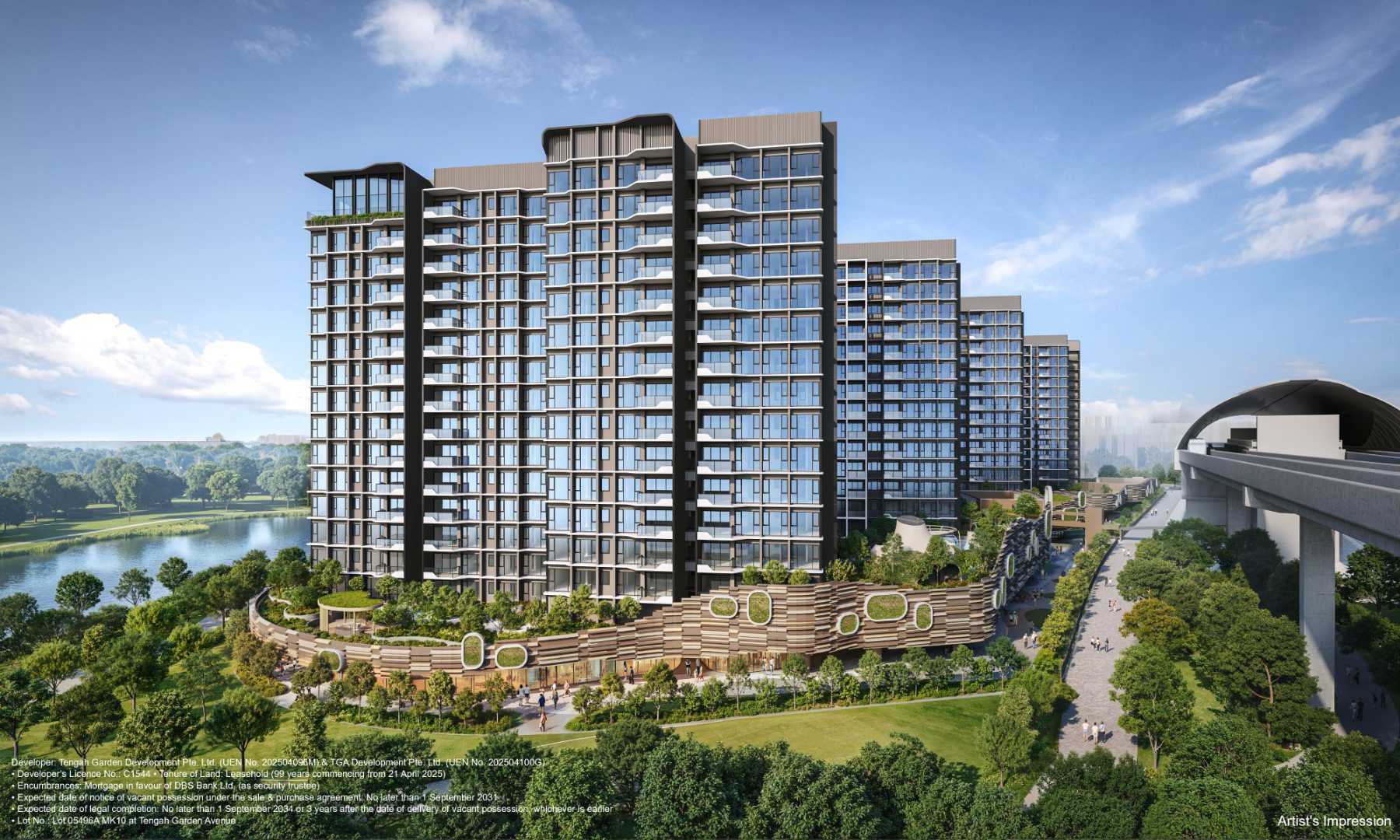
Tengah Garden Residences is a 99-year leasehold, integrated mixed-use development situated along Tengah Garden Avenue in District 24. Developed by a consortium comprising Hong Leong Holdings, GuocoLand, and CSC Land Group under the Government Land Sales (GLS) programme, the project is positioned directly beside Hong Kah MRT (JS4) on the Jurong Region Line — making it the first private condominium to be introduced into Tengah, Singapore's purpose-built "Forest Town."
Rather than functioning as a conventional Outside Central Region (OCR) suburban project, Tengah Garden Residences is best understood as a first-mover, infrastructure-led development. Its core appeal lies in direct MRT adjacency, an on-site commercial podium designed to serve a growing BTO population, and long-term town maturation tied to the Jurong Region Line, the Jurong Innovation District, and the Jurong Lake District.
Following its launch, the project saw strong take-up across key unit types, with demand concentrated in entry-level and mid-sized layouts. This shifts the buyer's decision away from broad market positioning and toward a more specific evaluation of remaining options — assessed through layout fit, affordability, and long-term holding alignment within a developing township.
This review examines Tengah Garden Residences from a decision-stage perspective: who the project realistically suits, what buyers are paying for, and the trade-offs involved in entering a new township at an early stage.

Project Factsheet
Item | Details |
|---|---|
Project Name | Tengah Garden Residences |
Location | Tengah Garden Avenue |
District / Region | District 24 / OCR (West Region) |
Tenure | 99-year leasehold |
Developer | Hong Leong Holdings, GuocoLand & CSC Land Group |
Site Type | GLS (New Launch) |
Development Type | Integrated Mixed-Use Development |
Site Area | 25,458.4 sqm |
Plot Ratio | 3.0 |
Total Units | 863 residential units |
Nearest MRT | Hong Kah MRT (JS4), Jurong Region Line |
Estimated TOP | September 2031 |
Location Context: Infrastructure Before Maturity
Tengah Garden Residences occupies a position where infrastructure has been established ahead of lifestyle maturity. The immediate surroundings will remain transitional for several years, but the structural foundations are already in place.
Direct access to Hong Kah MRT (JS4) gives the development a permanent transport advantage in a town designed around car-lite mobility. Unlike many OCR projects that depend on rail connectivity that is planned but not yet confirmed, Tengah Garden Residences sits beside an operational station on the Jurong Region Line (JRL) — a line built to connect Tengah with Jurong East, the Jurong Innovation District, and employment hubs across the western corridor. As surrounding residential density grows, this proximity becomes progressively more valuable.
The integrated commercial podium reinforces the development's role as an interim town node. Until Tengah Town Centre reaches full completion, daily services, groceries, and neighbourhood activity are likely to concentrate around integrated developments that serve nearby BTO clusters. Convenience here is built on function rather than lifestyle branding.
The ACS (Primary) Relocation Effect
The planned relocation of Anglo-Chinese School (Primary) to Tengah introduces a forward-looking demand consideration. Tengah Garden Residences falls within the 1 to 2 km admission radius, placing it within range for families planning housing decisions several years ahead of school enrolment.
This factor does not generate immediate demand, but it shapes long-term buyer behaviour — particularly among households with younger children who are making property decisions in anticipation of future school phases.
Talent Hub: The Western Growth Corridor
Tengah Garden Residences benefits indirectly from the proximity of both the Jurong Innovation District (JID) and the Jurong Lake District (JLD). Its role is primarily residential — effectively housing professionals employed in advanced manufacturing, research, and technology sectors across western Singapore.
This dynamic supports stable own-stay and rental demand, though it does not generate prestige-driven or speculative price momentum. Demand here is practical and income-linked rather than lifestyle-led.
What Tengah Garden Residences Is and Is Not
What it is:
The first private condominium establishing Tengah's private-market pricing benchmark
An MRT-integrated, mixed-use development prioritising daily convenience
A long-horizon own-stay and early-entry growth play for the western corridor
What it is not:
Not a mature estate experience at or near launch
Not a low-density boutique development
Not designed for short-term trading or EC-style price momentum
Structural Positioning at a Glance
Feature | Implication |
|---|---|
MRT adjacency | Long-term transport advantage in a car-lite town |
Integrated commercial podium | Daily convenience and neighbourhood services |
First private condo in Tengah | Establishes the pricing benchmark for the town |
New township environment | Early-cycle entry with long-term growth alignment |
Amenities and Site Planning: Functional, Not Lifestyle-Led

Tengah Garden Residences is structured as a large-scale, family-oriented development, with facilities designed around daily use rather than lifestyle branding.
The development is organised around a central landscape and water spine, meaning most stacks face greenery rather than roads. Facilities are distributed across the site in multiple zones rather than concentrated in a single deck, and sky terraces on Blocks 13, 15, and 17 provide elevated amenity spaces including dining pavilions, yoga decks, and viewing terraces. Lagoon-style pools and family zones further reinforce its positioning as an own-stay development.
A few practical considerations are worth noting: with 863 units, shared facilities will experience meaningful usage levels. Internal-facing stacks vary in terms of distance and privacy depending on their position within the site. The overall concept prioritises functional liveability over exclusivity.
For families planning a long-term stay, this layout is well-suited. For buyers seeking a boutique or lifestyle-driven residential concept, it may feel less aligned.
Buyer Suitability
Best suited for:
Families with a 5 to 10-year holding horizon
Buyers priced out of Executive Condominiums but seeking private housing in the West
Households comfortable entering a town before full infrastructure is in place
Professionals working in or around the Jurong Innovation District and Jurong Lake District
Likely to be less satisfied:
Buyers expecting immediate neighbourhood maturity
Those sensitive to ongoing construction activity in surrounding areas
Short-term investors focused on launch-to-TOP price appreciation
The Core Trade-Off
Buyers entering Tengah Garden Residences are effectively exchanging patience and a transitional environment for first-mover positioning, MRT adjacency, and long-term exposure to Tengah's development trajectory. This is a structural trade-off that cannot be priced away.
With entry pricing positioned close to Executive Condominium levels, the decision has evolved beyond timing. Buyers are now evaluating whether the remaining unit types, pricing tiers, and layout options are genuinely aligned with their affordability, household needs, and holding horizon.
Pricing Logic and Buyer Segmentation
Tengah Garden Residences entered the market at levels structurally closer to Executive Condominium benchmarks than to typical private integrated developments. The key observation is not a specific figure but a pattern: entry quantum falls within a range typically associated with EC buyers, with certain unit types priced in direct overlap with EC comparison thresholds — despite this being a private, MRT-integrated mixed-use development.
This creates a situation where pricing is evaluated not in isolation, but in direct comparison with the alternative housing pathways available to the same buyer group.
Why This Matters
Unlike ECs, Tengah Garden Residences offers no eligibility restrictions, no Minimum Occupation Period, and full ownership flexibility from day one. Yet its entry pricing sits within a range that many EC buyers would seriously consider. This fundamentally changes the comparison framework: buyers are effectively choosing between a subsidised EC model with restrictions, or entering private housing early with full flexibility but without the subsidy.
How Pricing Is Likely to Move
Early-cycle township developments like this one tend to see appreciation tied to infrastructure completion milestones rather than market sentiment. Because entry pricing was not set aggressively, subsequent price movement may feel more measured and gradual rather than delayed. Unlike EC repricing, which is often driven by subsidy-related gaps closing at the five-year MOP, Tengah Garden Residences depends on time compression — the narrowing of price gaps as the township matures.
Absolute Quantum vs PSF
For this project, total quantum matters more than PSF as a decision lens. Core buyers are own-stay families, not short-term traders. Larger unit sizes increase sensitivity to total price. And buyers are actively comparing across ECs, resale condos, and future Tengah launches. At current pricing levels, the project occupies a narrow decision band — affordable enough to be compared with ECs, but structured and positioned as a private integrated development.
URA Master Plan Context: Tengah as a Structural Growth Play
URA's vision for Tengah is programmatic and phased rather than speculative. Key planning elements include approximately 42,000 new homes across multiple districts, a 100-metre-wide and 5-kilometre-long Forest Corridor, a car-free town centre with smart mobility infrastructure, full Jurong Region Line connectivity by 2029, and integration with both the Jurong Innovation District and Jurong Lake District.
For Tengah Garden Residences, this planning context means its value proposition strengthens as intent is executed rather than simply announced. MRT-linked developments tend to benefit disproportionately as population density increases, and early integrated nodes in new towns tend to capture higher utility value over time. This is a slow-burn, planning-driven growth story — not a catalytic rezoning play.
Buyer Segmentation
Long-Horizon Own-Stay Families (Primary Segment)
Households planning seven to ten years or more, comfortable entering a developing town, and prioritising MRT access, schools, and future amenities. Town maturation aligns with family life cycles, and the ACS (Primary) relocation introduces a forward-looking demand pipeline.
"Aspirational Gap" Buyers Exceeding EC Income Ceilings
Buyers previously eligible for ECs who are now priced out, seeking private housing in the West without relocating east or centrally. They accept the trade-off between price and maturity in exchange for early private market entry without EC restrictions.
Pioneer Investors (Secondary, Selective)
Long-term, capital-growth-oriented investors familiar with township development cycles. MRT adjacency and future population density support rental and resale demand, but this is not a yield-driven play. Performance depends on patience rather than timing.
Short-Term Traders
This project is generally not well-suited for short-term trading. Unit count limits scarcity, there is no subsidy-driven price gap, and the early years will be shaped by construction-phase sentiment.
Exit and Liquidity Analysis
Liquidity Profile
For early-cycle township condominiums, resale demand is primarily family-driven, liquidity improves meaningfully post-TOP as the town matures, and early resale years may see thinner buyer pools. This creates stability over time but limits short-term upside.
Unit-Type Liquidity Tendencies
Two-bedroom units tend to have the broadest buyer pool and strongest liquidity. Three-bedroom units carry stable resale potential driven by core family demand. Larger units are more selective and income-sensitive.
Timing Sensitivity
Exit outcomes here are more sensitive to interest rate cycles, household income growth, and the completion of JRL and surrounding amenities. They are less sensitive to launch-day PSF optics or short-term market sentiment.
Risk Scenarios
Prolonged High Interest Rates: Affordability pressure increases, but family demand stabilises prices while limiting upside.
Slower Tengah Build-Out: Delayed lifestyle maturity places greater weight on buyer patience; weak-handed holders may exit early.
Strong Jurong Employment Growth: Increased housing demand supports both rental and resale absorption.
Shift Toward Integrated Living: MRT-adjacent projects within Tengah outperform, acting as a structural tailwind for this development.
Pros and Cons Summary
Pros
First private condominium in Tengah, establishing the pricing benchmark
Direct MRT adjacency to Hong Kah station on the Jurong Region Line
Integrated commercial podium providing daily convenience
Backed by long-term URA planning intent and town infrastructure
Cons
Estate immaturity at launch, with a transitional environment for several years
Ongoing construction activity in surrounding areas
Limited short-term upside for non-patient buyers
Large project scale with 863 units means lower scarcity relative to boutique developments
Takeaway
Tengah Garden Residences works best for buyers who are comfortable being early — early into Tengah, early into its private-market pricing benchmark, and early into the West's next growth corridor. With strong initial take-up, the question is no longer whether to enter, but whether the remaining unit types and pricing tiers are genuinely aligned with your affordability, layout needs, and holding horizon.
Frequently Asked Questions
Is Tengah Garden Residences primarily for own-stay buyers or investors?
It is structured primarily for own-stay buyers. Most demand comes from families and upgrader households who value MRT access, integrated convenience, and long-term town development. Investor interest exists but is expected to be long-horizon and capital-growth focused rather than yield-driven.
Does being the first private condo in Tengah increase risk?
Yes, entering early carries estate-maturity risk, as surrounding infrastructure and amenities will take time to fully develop. However, it also allows buyers to enter at the lowest private-market benchmark in the town. The risk-reward trade-off depends heavily on holding period and tolerance for near-term inconvenience.
How important is the Hong Kah MRT location?
Direct access to Hong Kah MRT is one of the project's most important structural advantages. In a car-lite town like Tengah, immediate rail connectivity materially improves daily convenience and long-term desirability. This advantage becomes more pronounced as surrounding residential density increases.
Will nearby construction activity affect liveability?
Construction activity in Tengah is expected to continue for several years as the town develops. Buyers sensitive to noise, dust, or a transitional environment may find this challenging in the near term. Those with longer time horizons tend to view this as a temporary phase.
Is Tengah Garden Residences comparable to nearby Executive Condominiums?
Only partially. While buyer profiles may overlap, this is a private condominium without EC eligibility restrictions or a Minimum Occupation Period. The comparison becomes most relevant when the pricing gap between ECs and private housing narrows, and buyers begin evaluating flexibility and long-term ownership structure alongside price.
Does the planned ACS (Primary) relocation materially affect demand?
It is a forward-looking demand driver rather than an immediate one, most relevant for families with younger children making housing decisions several years in advance. It does not guarantee demand, but it introduces a structural family-buyer pipeline over time.
Should buyers wait for later Tengah private launches instead?
Later launches may benefit from a more developed town environment but are also likely to be priced higher as infrastructure matures. The decision depends on whether buyers prefer early entry at a lower benchmark or greater maturity at a higher price point.
What is a realistic holding period?
A realistic holding period is seven to ten years or longer. This timeframe allows buyers to benefit from Tengah's gradual infrastructure completion, MRT connectivity, and growing residential density. Shorter holding periods may expose buyers to the transitional phase of a developing town.
Is rental demand expected to be strong?
Rental demand is expected to be steady rather than speculative, driven by professionals working in the Jurong Innovation District, Jurong Lake District, and nearby western employment zones. Because Tengah is primarily a residential town rather than an expatriate enclave, rental demand will grow gradually alongside population and infrastructure development.
How risky is buying before Tengah fully matures?
Buying into a newly developing town involves timing risk rather than structural risk. The surrounding environment may take several years to reach full maturity, but the town's planning framework, MRT connectivity, and residential density targets are already confirmed within Singapore's urban planning system. The key risk lies in holding horizon alignment rather than project viability.
Interested in Tengah Garden Residences?
Get the latest pricing and stack recommendations from a verified consultant — no obligation.