
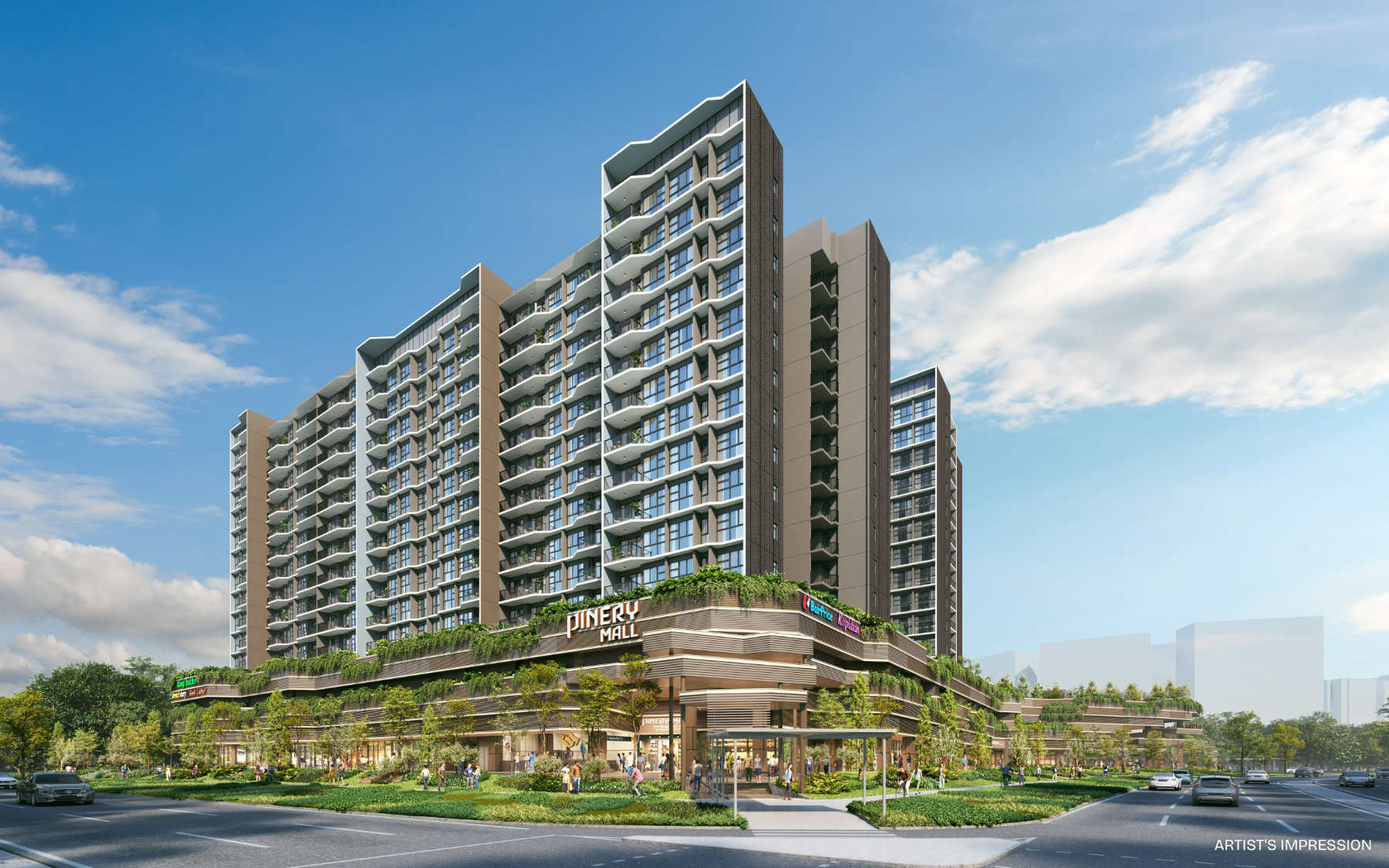
Pinery Residences: Project Review for 2026 Buyers
Integrated MRT Living in Tampines for Long-Horizon Family Buyers (District 18)
View Pinery Residences Project Page →Summary
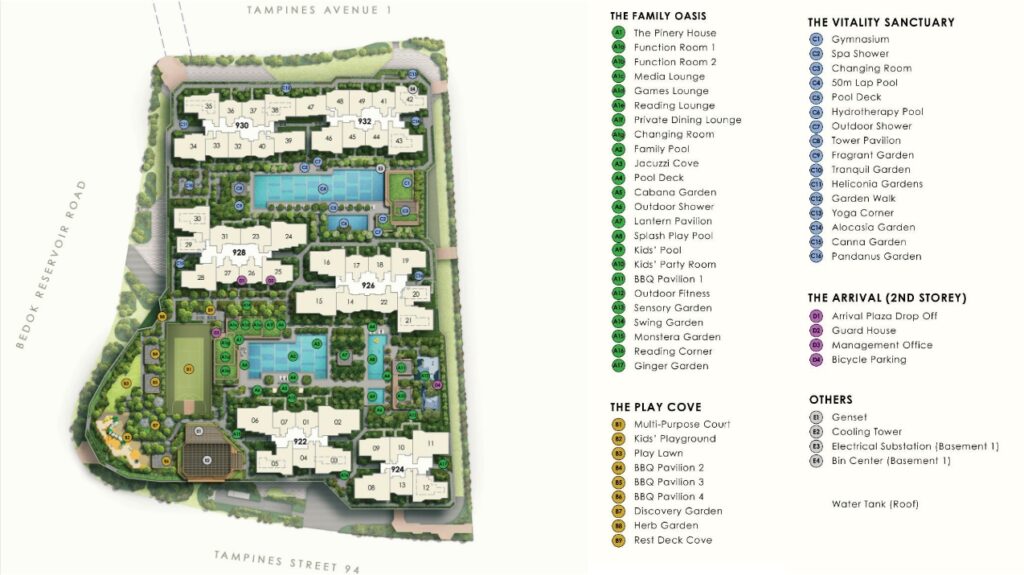
Pinery Residences is a 99-year leasehold integrated mixed-use condominium located at Tampines Street 94 in District 18, jointly developed by Hoi Hup Realty and Sunway Developments under the Government Land Sales (GLS) programme. The project comprises 588 residential units across six blocks positioned above a commercial podium, with a direct underground pedestrian connection to Tampines West MRT (DT31) on the Downtown Line.
The project is best understood as a family-centric, long-hold own-stay development. Its defining advantage is MRT integration combined with on-site daily conveniences, positioning it as a utility-first home within one of Singapore's most established regional centres. Buyers evaluating Pinery Residences should approach it through the lens of daily efficiency, transport integration, and long-term liveability — rather than scarcity, lifestyle branding, or short-term price momentum.
With its preview phase completed, the project is in active selection. The question at this stage is no longer about early entry positioning. It is about whether the remaining units justify the pricing premium over non-integrated alternatives and nearby Executive Condominiums.
Project Factsheet
Item | Details |
|---|---|
Project Name | Pinery Residences |
Address | 51 to 71 Tampines Street 94, Singapore |
District / Region | District 18 / OCR / Tampines Planning Area |
Tenure | 99 years leasehold from 7 January 2025 |
Developer | Hoi Hup Realty and Sunway Developments |
Site Area | 23,512 sqm |
Plot Ratio | 2.63 |
Total Residential Units | 588 |
Unit Mix | 2 to 5 Bedroom |
Nearest MRT | Tampines West MRT (DT31), direct underground access |
Development Type | Integrated mixed-use with commercial podium and MRT link |
Expected TOP | April 2030 |
Unit Mix at a Glance
Unit Type | Size Range (sqft) | No. of Units | % of Total |
|---|---|---|---|
2 Bedroom | 624 to 667 | 180 | 30.6% |
2 Bedroom + Study | 700 | 72 | 12.2% |
3 Bedroom | 807 to 1,023 | 144 | 24.5% |
3 Bedroom + Study | 1,055 | 60 | 10.2% |
4 Bedroom | 1,141 | 24 | 4.1% |
4 Bedroom + Study | 1,195 to 1,389 | 96 | 16.3% |
5 Bedroom | 1,475 | 12 | 2.0% |
The absence of 1-bedroom units and the strong weighting toward 3 and 4-bedroom configurations signal that Pinery Residences is designed primarily for family owner-occupiers. Approximately 77% of supply sits in 2 and 3-bedroom formats, while over 20% is allocated to 4 and 5-bedroom units — an unusually family-weighted distribution for an OCR integrated development.
Location: Tampines as a Mature Regional Centre
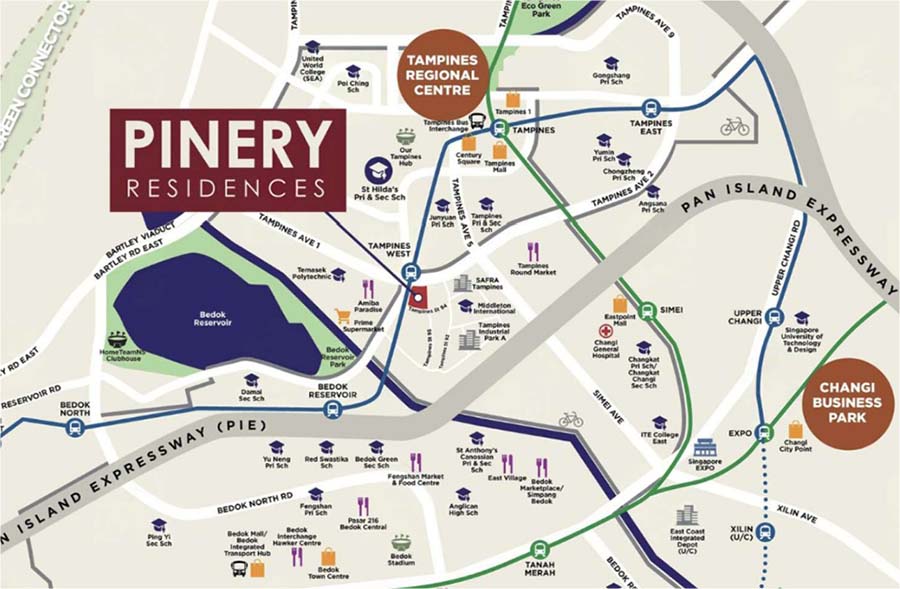
Pinery Residences sits within Tampines, one of Singapore's most complete and self-sufficient regional centres. Unlike emerging estates that depend on future infrastructure delivery, Tampines already provides a full ecosystem of transport, schools, retail, healthcare, recreation, and employment access. This materially reduces the lifestyle execution risk that buyers in newer towns must accept.
The project's most significant structural attribute is its direct underground pedestrian link to Tampines West MRT (DT31). This connection improves commuting reliability to the city, Bugis, and Changi Business Park, and reduces dependence on feeder buses or private vehicles. For families managing work, school, and daily errands simultaneously, this level of connectivity accumulates in practical value over time.
Beyond the MRT link, residents benefit from proximity to Our Tampines Hub, SAFRA Tampines, Bedok Reservoir Park, and a dense network of primary and secondary schools. Tampines functions as a live-work-play hub rather than a dormitory town, which is one of the primary reasons integrated developments here tend to attract stable, long-term own-stay demand.
What Pinery Residences Is and Is Not
Pinery Residences is a fully integrated private residential development designed primarily for family own-stay buyers. It is anchored within a mature regional centre and focused on daily convenience and transport-led living. Its commercial podium supports everyday needs rather than acting as a destination retail experience, and its MRT connection provides practical daily utility rather than a prestige feature.
What it is not: a boutique or low-density enclave, a prestige-driven lifestyle development, a project suitable for short-term trading, or a quiet suburban pocket. It deliberately trades serenity and exclusivity for connectivity, accessibility, and integration. Buyers who understand and accept that trade-off will find the project coherent. Those expecting something different will likely be disappointed.
Amenities and Integration
Transport Direct underground access to Tampines West MRT (DT31) on the Downtown Line. Extensive bus services operate along Tampines corridors for secondary connectivity.
On-Site Commercial Podium A FairPrice supermarket, Kopitiam food court, childcare and early childhood facilities, community plaza, and daily retail are all available within the development. These services reduce the need for daily trips beyond the building and are particularly relevant for families with young children and working adults with limited free time.
Surrounding Amenities Our Tampines Hub, Tampines Mall, and Century Square are within easy reach. SAFRA Tampines and Bedok Reservoir Park provide recreational options. The surrounding school network is comprehensive across primary and secondary levels.
The podium's role is functional rather than aspirational. It reduces daily friction over long holding periods, which is a structural advantage for households planning to stay for seven to twelve years or more.
Pricing Logic
Pinery Residences was acquired at a GLS land rate of approximately $1,004 psf per plot ratio, reflecting the premium attached to MRT integration and mixed-use development costs. This structurally elevates the pricing floor, but land cost explains pricing pressure rather than pricing success. In OCR markets, buyers ultimately decide whether the total quantum fits within realistic family affordability bands.
For family-oriented OCR developments, absolute quantum is more relevant than headline PSF. Buyers prioritise monthly mortgage sustainability, CPF and cash buffer after purchase, and long-term holding comfort. MRT integration improves buyer tolerance for higher PSF, but it does not eliminate quantum sensitivity. If 3 and 4-bedroom pricing pushes too close to higher-end OCR or entry-level RCR benchmarks, comparison pressure against ECs and resale condominiums increases regardless of integrated features.
One of the project's structural considerations is direct comparison with nearby Executive Condominiums, particularly Rivelle Tampines. Both products compete for similar upgrader households, school catchments, and transport nodes. Pinery's advantages are immediate private status, MRT integration, and rental flexibility. ECs retain a meaningful entry-price advantage. The pricing gap must feel justified by genuine utility and convenience rather than marketing positioning alone.
URA Planning Context
URA's long-term framework for Tampines emphasises decentralisation, transport-led growth, and people-centric town planning. Key planning priorities include reduced car dependency, integrated transport infrastructure, and mixed-use intensification around major nodes. Pinery Residences sits squarely within this intent through its MRT link and commercial podium.
URA planning does not promise capital appreciation. It supports demand stability, lifestyle resilience, and lower obsolescence risk over time. For Pinery Residences, alignment with planning intent reinforces its long-term own-stay appeal rather than creating speculative price catalysts. Buyers should expect steady, fundamentals-led performance rather than sharp appreciation cycles.
Buyer Suitability
Family own-stay buyers form the primary segment. These households prioritise MRT access, school proximity, town-centre convenience, and the reduction of daily friction. They are less sensitive to short-term price movements and more focused on whether the home works reliably year after year. The unit mix — with no 1-bedroom supply and significant 3 and 4-bedroom allocations — reinforces this as the intended buyer profile.
HDB upgraders from Tampines and Bedok represent the core demand base. Familiarity with the area, school continuity, and established commuting patterns heavily influence decisions. Pricing tolerance exists, but only up to the point where the upgrade continues to feel financially rational given the available alternatives.
Long-horizon investors may find a secondary case here, primarily for buyers focused on tenant depth and stable rental demand rather than yield maximisation. Pinery Residences is not designed for speculative or yield-chasing capital.
Buyers who should look elsewhere include those seeking boutique exclusivity, quieter low-activity environments, or short-term price momentum. These are structural limitations of the project's design intent, not deficiencies.
Exit and Liquidity
Liquidity for integrated OCR developments is steady rather than spiky, driven primarily by family demand and sensitive to affordability cycles rather than short-term market sentiment.
Two-bedroom units carry the broadest buyer pool and strongest transactional depth due to lower absolute quantum. Three-bedroom units form the core family resale market and should anchor demand stability over time. Four-bedroom configurations, while well-suited for larger families, represent a substantial supply allocation, and liquidity during tighter affordability cycles may narrow. The 5-bedroom segment, with only 12 units, has genuine scarcity within the project.
Exit outcomes are more influenced by the interest rate environment, household income growth, and OCR affordability conditions than by launch-day momentum or short-term sentiment. A holding period of seven to twelve years or longer is appropriate and allows buyers to benefit from the gradual maturation of surrounding infrastructure and the accumulated convenience value of MRT integration.
Risk Scenarios
Prolonged high interest rates tighten affordability, particularly for larger units. Integrated convenience helps sustain demand, but buyers become more price-disciplined. Entry pricing discipline matters more than product features in this environment.
Broad OCR market correction places pressure on all projects regardless of features. Pinery's integration provides some buffer against the sharpest adjustments, but it does not provide immunity from broader market repricing.
Strong residential recovery allows Pinery to participate in the recovery cycle, though it is unlikely to lead price appreciation given its large scale and OCR positioning. Upside tends to be gradual rather than explosive.
Rising preference for transit-oriented living is the most favourable long-term scenario for this project. Growing acceptance of MRT-integrated convenience living supports sustained and consistent demand over time.
Pros and Cons
Pros
Direct underground MRT access to Tampines West (DT31) on the Downtown Line
Mature regional centre with comprehensive surrounding amenities
Family-oriented unit mix weighted toward 3 and 4-bedroom configurations
Strong alignment with URA's planning direction for Tampines
On-site daily conveniences reduce everyday friction for working families
Cons
Large scale at 588 units limits scarcity and caps speculative upside
99-year leasehold tenure
Elevated pricing due to land cost and integration premium creates quantum sensitivity
Not suitable for buyers seeking boutique living, quiet environments, or short-term gains
High activity levels from the commercial podium require careful unit orientation selection
Takeaway
Pinery Residences competes on integration and structural convenience rather than scarcity or lifestyle branding. Its MRT link and family-oriented planning are genuine advantages for households who value daily efficiency and town-centre completeness. For buyers evaluating it through a long-term own-stay lens with realistic pricing expectations, the positioning is coherent and defensible. For those expecting boutique exclusivity or rapid price uplift, expectations need to be recalibrated before committing.
Frequently Asked Questions
Is Pinery Residences mainly an own-stay project or an investment?
It is primarily designed for own-stay buyers. Its value derives from MRT integration, daily convenience, and family usability rather than rental yield or short-term price movement. While rental demand exists due to Changi Business Park proximity, it is secondary to owner-occupier demand. Buyers should evaluate it as a long-horizon home.
How important is the direct MRT integration in practice?
It is a structural advantage, not a cosmetic one. An underground sheltered link to Tampines West MRT reduces weather exposure and transfer friction compared to surface walking routes. For families managing work, school, and errands daily, this convenience compounds in value across years of occupation in a way that most marketed features do not.
Does the integrated commercial podium help or hurt liveability?
For most families, it improves daily liveability by shortening routine trips. The trade-off is higher activity during peak hours, which makes stack orientation and unit positioning more important. Convenience generally outweighs the drawbacks for own-stay households over the long term.
How does Pinery Residences compare with nearby Executive Condominiums?
ECs offer lower entry prices but come with income eligibility requirements, Minimum Occupation Period restrictions, and delayed resale flexibility. Pinery Residences trades a higher entry cost for immediate private status, no MOP, rental flexibility from day one, and direct MRT integration. The decision depends on eligibility, holding intent, and lifestyle priorities rather than which option is objectively superior.
Is 588 units too many for a single development?
Density is a relevant consideration but must be read in context. This is a transport-oriented mixed-use development where density supports retail viability and transit efficiency. Buyers seeking low-density serenity should look elsewhere. For buyers prioritising convenience, density is a functional characteristic rather than a drawback.
What is a realistic holding period?
Seven to twelve years or longer. Shorter horizons increase sensitivity to market timing and pricing volatility. Longer holds allow the benefits of MRT integration, planning alignment, and town-centre maturation to compound meaningfully. The project rewards patience rather than short-cycle thinking.
Who should avoid Pinery Residences?
Buyers seeking boutique exclusivity, quiet and low-activity surroundings, or short-term capital gains are misaligned with this project. These are not flaws — they are deliberate design trade-offs that make Pinery well-suited for some buyers and poorly suited for others.
Does URA planning support long-term value growth here?
URA planning supports liveability, connectivity, and long-term demand stability rather than speculative price cycles. For Pinery Residences, this means structural resilience and lower obsolescence risk over time, which is more valuable over a long holding period than the prospect of sharp near-term appreciation.
Interested in Pinery Residences?
Get the latest pricing and stack recommendations from a verified consultant — no obligation.