
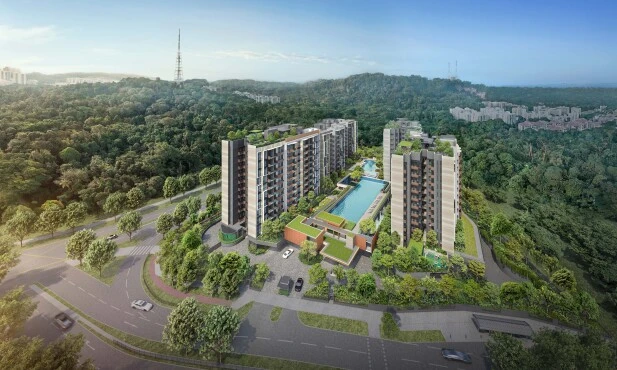
The Sen: Project Review for 2026 Buyers
Nature-Adjacent, Value-Led Family Living in Bukit Timah (District 21)
View The Sen Project Page →Summary
The Sen is a 99-year leasehold private residential development located along Jalan Jurong Kechil in District 21, within Singapore's Bukit Timah planning area. Developed by Sustained Land via a Government Land Sales (GLS) site, the project comprises five 10-storey residential towers with a total of 347 units.
The project is best understood as a value-led, owner-occupier-first development rather than a transport-driven or investment-led launch. Its primary appeal lies in relative affordability within a prestigious district, adjacency to nature parks and the Rail Corridor, and a lower-density residential character shaped by a 1.6 plot ratio. These attributes come with a significant and structural trade-off: Beauty World MRT is approximately 1.08 km away, placing the development firmly outside comfortable daily walking distance for most households. Buyers dependent on public transport for their daily commute will feel this consistently.
The Sen launched in November 2025 with approximately 23% take-up, a level that reflects deliberate and buyer-specific demand rather than broad market enthusiasm. This is consistent with the project's positioning as a pragmatic choice for owner-occupiers who drive and prioritise environment and space over transport immediacy.
Project Factsheet
Item | Details |
|---|---|
Project Name | The Sen |
Location | Jalan Jurong Kechil, Singapore |
District / Region | District 21 / Rest of Central Region |
Tenure | 99-year leasehold from 20 January 2025 |
Developer | Sustained Land Pte Ltd |
Site Type | GLS |
Development Type | 5 towers of 10-storey private residential buildings with basement carpark |
Site Area | 19,245.4 sqm |
Plot Ratio | 1.6 |
Total Units | 347 |
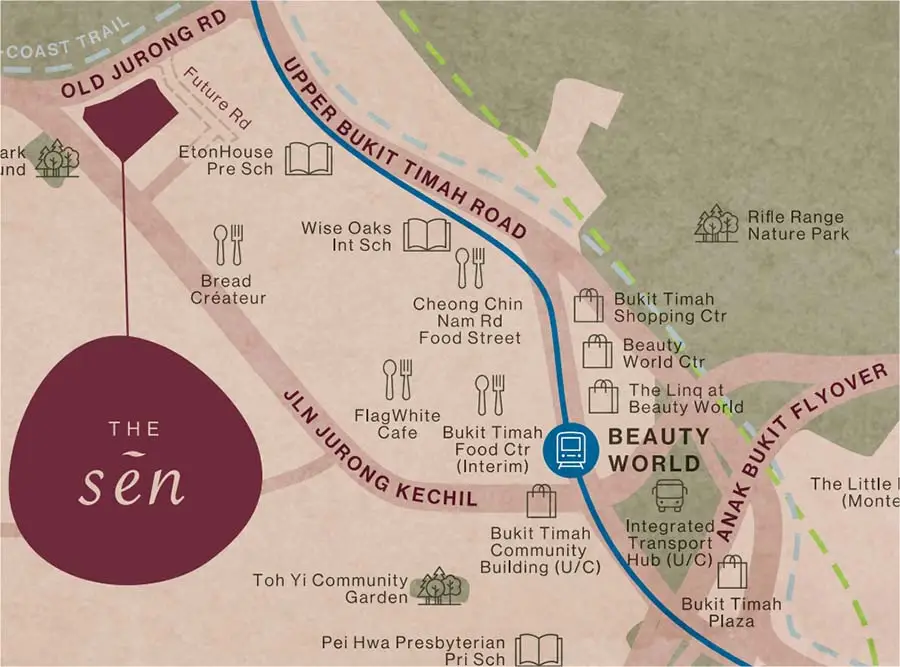
Nearest MRT | Beauty World MRT (DTL), approximately 1.08 km |
Launch Date | 15 November 2025 |
Expected TOP | August 2030 |
Location Context
The Sen sits along Jalan Jurong Kechil, a residential arterial road connecting Bukit Timah to Bukit Batok, rather than within a walkable MRT catchment. The nearest station, Beauty World MRT on the Downtown Line, is approximately 1.08 km away — a distance that places it outside the range most households are comfortable walking daily, particularly in Singapore's heat and humidity. Feeder buses and private vehicles are the practical daily transport modes for residents here.
This locational reality shapes the project's entire value proposition. The Sen aligns more closely with a traditional Bukit Timah residential enclave — where quality of surroundings, privacy, and lower density define the living experience — than with a transit-oriented condominium where MRT access is central to the lifestyle. Buyers who drive and value the character of the Bukit Timah corridor will find this coherent. Car-free households are likely to find the transport friction compounding over time.
On the positive side, the location delivers genuine environmental quality. Proximity to Bukit Batok Nature Park, the Rail Corridor, and surrounding green buffers gives the development a quieter and more pleasant day-to-day atmosphere than most comparably priced launches. This is a lifestyle benefit that is real and daily, even if it does not compensate for the absence of MRT convenience for transport-dependent buyers.
What The Sen Is and Is Not
The Sen is a price-led entry into a new District 21 development for owner-occupiers who drive and value a greener, lower-density residential environment. It is structured for families and households seeking a practical, long-term home within the Bukit Timah planning area at a more accessible quantum than MRT-adjacent or freehold alternatives.
What it is not: an MRT-centric or car-lite development, a freehold or prestige-driven Bukit Timah address, a lifestyle-branded or integrated retail project, or a development suited for rental-led investment strategies. Buyers who need any of these attributes should identify that mismatch early rather than allowing pricing to override it.
Scale and Site Design
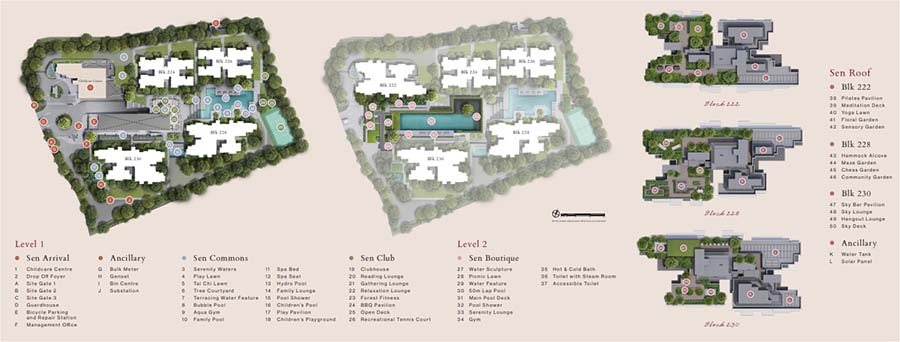
At 347 units across five 10-storey towers, The Sen occupies a middle ground between boutique low-density projects and large suburban estates. The scale is manageable enough to avoid the congestion of mega-developments while still supporting a reasonable communal facilities offer and a mandatory on-site Early Childhood Development Centre, which reinforces its family-oriented character.
The site's 1.6 plot ratio results in a lower-rise outcome that sits in keeping with the surrounding Bukit Timah residential corridor. However, block clustering means that some internal stacks face other blocks within the development, and privacy varies meaningfully by unit selection. Buyers should assess specific stacks rather than treating all units as equivalent in terms of openness and liveability.
Amenities and Connectivity
Transport Beauty World MRT (Downtown Line) is approximately 1.08 km away. Bus services along Jalan Jurong Kechil connect to surrounding areas for those without cars.
Nature and Recreation Bukit Batok Nature Park is approximately 0.5 to 0.8 km from the site. The Rail Corridor and surrounding green buffers are within close proximity, providing access to cycling and walking routes.
Schools Bukit Timah Primary School and Pei Hwa Presbyterian Primary School are in the wider area, though buyers relying on specific 1 km school catchment planning should verify exact distances by block rather than assuming coverage at a development level.
Daily Conveniences Bukit Timah Market and Food Centre is approximately 5 minutes by car. Beauty World Plaza and Bukit Timah Shopping Centre are accessible nearby.
The overall amenity profile suits households comfortable with car-based daily routines. Walking access to daily necessities and MRT is limited compared with more centrally located or integrated developments.
Structural Value and Tenure Considerations
As a 99-year leasehold development in a district where many boutique projects carry freehold tenure, The Sen's pricing reflects a deliberate affordability wedge relative to alternatives. Buyers pay less than they would for an equivalent freehold or MRT-fronting address, and in return they accept a finite lease, bus and car dependency, and fewer immediate surrounding amenities.
For owner-occupiers with a defined holding horizon who prioritise personal use and liveability over legacy ownership, this trade-off can be rational. Buyers who associate Bukit Timah addresses with long-term capital preservation and tenure security should assess this carefully. The district's prestige does not offset the practical implications of a 99-year lease in a freehold-heavy neighbourhood when resale timing eventually becomes relevant.
Buyer Suitability
HDB upgraders from Bukit Batok, Bukit Panjang, and Jurong form the primary buyer group. These households are already familiar with driving-centric lifestyles, value a Bukit Timah address, and are seeking private housing at a manageable entry quantum. The lack of MRT proximity is acknowledged but tolerable within the context of their existing daily routines.
Owner-occupiers downsizing from nearby landed or older private estates represent a meaningful secondary segment. For these buyers, the lower-rise surroundings, greenery, and layout efficiency of a new build are appealing, and they view The Sen as a practical consolidation rather than an aspirational upgrade.
Selective investors may enter opportunistically at lower price points, but they are not structural drivers of demand at this project. Weaker rental appeal due to car dependency, leasehold tenure, and abundant freehold alternatives in the district limit the investor case considerably.
Buyers who should eliminate The Sen early include car-free households dependent on daily rail commuting, those primarily motivated by school catchment proximity within 1 km, and yield-focused investors who need MRT-driven rental demand. These are structural mismatches that lower pricing alone cannot fully resolve.
Pricing Logic
The Sen's pricing is best understood as constrained by its positioning rather than driven by ambition. The development does not benefit from MRT adjacency, freehold tenure, or integrated amenities — three attributes that typically justify premium pricing in District 21. The market has consistently anchored its pricing against two reference points: higher-priced MRT-centric new launches around Beauty World, and older resale projects offering larger units but dated stock.
Buyers are effectively paying for district entry and usable space rather than convenience or prestige. Resistance emerges clearly once pricing approaches levels associated with MRT-linked or mixed-use developments, because at that point buyers simply redirect their budget toward better-connected alternatives regardless of The Sen's environmental or size advantages. This creates a practically enforced pricing ceiling that the market behaviour at launch reflected.
Entry pricing from approximately $993,000 for the 1-bedroom configuration positions The Sen as one of the most accessible new-build entry points in District 21. For families, the 3-bedroom range from approximately $2.0 million to $2.8 million competes on quantum accessibility relative to comparable-sized units in Beauty World-adjacent launches.
URA Planning Context
URA's planning approach to the Bukit Timah corridor is one of lower-rise residential character, environmental integration, and gradual densification rather than transit-led intensification. Jalan Jurong Kechil is classified as a residential artery rather than a growth node, which means the surrounding environment is unlikely to transform dramatically in ways that would change the project's fundamental liveability profile.
The Draft Master Plan 2025 outlines transformation plans around Turf City and Beauty World, but these are spatially and functionally distinct from The Sen's immediate location. Future planning improvements in the wider district should be understood as incremental liveability support rather than a catalyst for sudden price re-rating at this specific site.
The mandatory Early Childhood Development Centre on-site reinforces the development's community-serving residential intent. Unlike commercial retail components, it does not introduce sustained foot traffic or noise into the residential environment.
Exit and Liquidity
Resale liquidity for The Sen is expected to be functional but selective. Future buyers are most likely to be families or households priced out of MRT-centric or freehold Bukit Timah options who are willing to accept the same transport trade-offs as today's buyers. This creates a reasonably consistent but narrow demand pool.
The resale audience narrows significantly for car-free households and rental investors, which limits liquidity during softer market cycles. Lower entry quantum provides some insulation against sharp price corrections, but it does not substitute for the broader demand pool that MRT proximity or freehold tenure would provide.
A holding period of seven to ten years or longer is appropriate. Shorter horizons increase exposure to market timing risk in a project where appreciation is expected to be gradual rather than event-driven.
Risk Scenarios
Transport relevance risk: If buyer preferences continue shifting toward car-lite living, particularly among younger households, projects without walkable MRT access may face sustained demand pressure at resale.
Competing supply risk: Future GLS launches in similar price and location bands could introduce newer alternatives and increase comparison pressure on resale units.
Tenure perception risk: As the lease advances, comparison against freehold boutique developments in District 21 becomes progressively less favourable, particularly for buyers focused on long-term capital preservation.
Positive scenario — sustained nature preference: If the post-pandemic shift toward quieter, greener residential environments remains structurally durable, The Sen's environmental positioning continues to support consistent demand from a defined buyer segment.
Pros and Cons
Pros
One of the most accessible new-build entry points in District 21
Nature-adjacent environment with proximity to Bukit Batok Nature Park and the Rail Corridor
Lower-rise planning consistent with the Bukit Timah residential character
Efficient post-harmonisation layouts that maximise usable space
Genuine quietness and liveability for households comfortable with driving
Cons
Beauty World MRT is approximately 1.08 km away, with no practical walk-to-MRT daily commute
99-year leasehold tenure in a district where freehold alternatives are abundant
Limited immediate street-level amenities
Narrower resale and rental buyer pool compared with MRT-fronting projects
Capital appreciation expected to be gradual rather than event-driven
Takeaway
The Sen is a pragmatic, value-oriented launch in District 21 for a clearly defined buyer: owner-occupiers who drive, value greenery and quieter surroundings, and want to access the Bukit Timah market at a lower entry quantum than MRT-adjacent or freehold alternatives require. For these buyers, the trade-offs are explicit and manageable. For anyone requiring MRT convenience, freehold tenure, or investment-grade rental demand, those mismatches should be identified early and the project eliminated accordingly.
Frequently Asked Questions
Is The Sen primarily for own-stay or investment?
It is structured as an own-stay-first development. Its distance from MRT, reliance on buses or private transport, and 99-year tenure reduce its attractiveness to yield-focused or short-cycle investors. Some opportunistic investors may enter at lower price points, but they are not driving demand.
How does the MRT distance affect long-term resale?
It materially narrows the resale buyer pool, particularly among younger households and car-lite families. Future buyers are more likely to be driving owner-occupiers rather than tenants or investors seeking convenience-led locations. This typically produces slower resale velocity compared with MRT-fronting projects, even when pricing is competitive.
Who is least suited to The Sen?
Car-free households dependent on daily rail commuting, buyers whose primary motivation is freehold tenure in Bukit Timah, and investors requiring strong MRT-driven rental demand are structurally misaligned. These mismatches persist regardless of pricing incentives.
Does the Bukit Timah address support long-term value?
District 21 retains appeal among families who value environment, space, and lower density, but the address alone does not override transport considerations for all buyers. Its relevance depends on the specific buyer profile.
Is the leasehold tenure a significant concern?
It is worth taking seriously in a district where many competing developments are freehold. Buyers planning very long holds or seeking legacy ownership should weigh this carefully. For buyers with a defined seven to twelve year personal-use horizon, it may be an acceptable trade-off for the pricing savings.
What is the right holding period?
Seven to ten years or longer is appropriate given the gradual appreciation profile and the time needed for the surrounding area to benefit incrementally from planning improvements. Shorter windows increase exposure to market timing risk.
Interested in The Sen?
Get the latest pricing and stack recommendations from a verified consultant — no obligation.